Converting Functional Areas to Cells
Application of Socio-Technical Principles

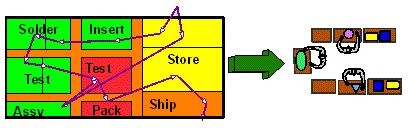
This table shows how various elements of the production system change when converting from a typical functional layout to cellular manufacturing. It also shows the relevant Socio Technical Systems design principle. The successful application of these principles depends greatly on the quality of the workcell design. In our experience, most workcell designs do not use these principles effectively and opportunities are lost.
Work Assignment
| Functional Departments | Workcell | STS Principle |
|
■ Workers assigned to single-function departments with no cross-training. ■ While the departments may be theoretically balanced, practical balance is near impossible. ■ Workers rarely move between departments. ■ Workers have little appreciation for how their own work may affect other stations. |
■ Workers rotate assignments and move among stations to assist each other and balance work. ■ Workers from any station can move to a bottleneck station for temporary assistance. The group actively encourages this and achieves near-perfect balance both short and long term. ■ Workers with superior skills can effectively use such skills to assist others and raise team productivity. ■ Workers understand interrelationships between tasks. |
1.3 Reduce wide variations in knowledge levels and variety through cross training. 3.2 Give workers larger and more varied tasks and increase cycle time. |
Motivation
| Functional Departments | Workcell | STS Principle |
|
■ Workers and supervisors have little concern for overall output. ■ Primary motivation is to not get fired (Lower order need) and any group loyalty is directed to the functional department. |
■ Individuals are committed to team performance and set their own production and quality goals. ■ Peer pressure resolves most discipline problems. ■ Group interaction fulfills social and esteem needs. |
1.4 Achieve High performance through commitment rather than minimal compliance. Use more carrot than stick. 1.6 Provide opportunities to satisfy unfulfilled higher order needs. Use the intrinsic motivators. |
Commitment
| Functional Departments | Workcell | STS Principle |
|
■ Engineers design the layout. |
■ Workers participate in the planning, design and task definition. ■ Workers establish rules and norms for their team. |
1.5 Build commitment by involving people in the shaping of their future. |
Training
| Functional Departments | Workcell | STS Principle |
|
■ Training is specific to one department and one type of operation but many products. |
■ Task training and cross training is done within the group. ■ Workers learn from the experience of others as well as from performing multiple tasks. ■ Team process learning occurs as the team coalesces and matures. |
1.7 Adult learning occurs primarily through experience. Integrate learning on the job through advisors, facilitators, and guided application. |
Quality
| Functional Departments | Workcell | STS Principle |
|
■ Quality is controlled by sampling output of a single operation and by final inspection at Shipping. ■ Some incoming inspection attempts to control input quality of parts. |
■ The entire workcell team is trained for normal inspection and process control procedures. ■ SPC is utilized at specific workstations and maintained by the team. ■ SPC is applied rigorously to incoming parts. |
2.1 Control variances at their source. 2.2 Ensure that the detection of a variance and the source of that variance occur in the same work group. 2.3 Maintain quality by detecting variances in the process rather than in the final product. 2.4 Monitor inputs as carefully as outputs. |
Process Technology
| Functional Departments | Workcell | STS Principle |
|
■ Equipment is optimized for direct labor across many products. Little consideration is given to indirect labor, particularly to material storage and movement as that belongs to another department. ■ Automation is expensive because it must accommodate numerous products. ■ Automation of indirect tasks such as handling (AGV, ASRS) is sometimes applied but is very expensive because of the variety of material movement. |
■ Because each cell builds only a few highly similar models, fixtures are optimized and specific tools readily available. ■ Some operations are more easily automated with simple automation such as nut runners. ■ Certain processes can use simpler equipment because it can be purchased and optimized for only one or two models. ■ Because of lower total volume, some equipment is more manual and increases direct labor. However, this is usually offset by overall efficiency improvements. |
2.6 Match technological flexibility with the product mix. 2.7 Match technology scale with production volume of the work groups. 3.4 Optimize the system rather than the system's components. |
System Design
| Functional Departments | Workcell | STS Principle |
|
■ System designed by separate engineering department with little direct input from workers. ■ System designed from mechanistic standpoint with only token consideration of probabilistic effects or indirect labor effects and no consideration for psychological or social effects. |
■ Workers participate in the planning, design and task definition. ■ STS principles employed during the design phase. |
3.1 Design the Socio and Technical systems simultaneously and jointly. |
Support Functions
| Functional Departments | Workcell | STS Principle |
|
■ All traditional support functions are performed by other departments. These include: Maintenance, Engineering, Human Resources, Scheduling and Quality. |
■ Many support functions become team responsibilities with assistance from functional departments for difficult situations. ■ Team responsibilities include scheduling, routine maintenance, setup, housekeeping, quality, process improvement, and some HR functions. |
3.3 Integrate support functions within work groups to the largest possible extent. |
Management
| Functional Departments | Workcell | STS Principle |
|
■ Supervisors manage all daily work including task assignments and problem-solving. ■ Supervisors are highly directive leaving little opportunity for individual growth, learning or interpretation. ■ When supervisors are unavailable, individuals take no initiative and simply wait for the supervisor to return. ■ Upper management sets goals and monitors compliance with little input from supervisors and no input from workers. While management may measure overall system performance, supervisors have little control over system performance. ■ Cultural management consists of motivational posters and an occasional pep talk. |
■ Work teams manage all daily work. ■ Supervisors have become coaches. They encourage the team to resolve problems and only intercede when the team is unable to do so. ■ Coaches are the primary contacts with external departments and parties. ■ Upper management actively manages the culture through training, example, recognition and coaching. |
4.1 Allow teams to manage the daily work. 4.2 Coach and facilitate rather than supervise. 4.3 Coaches should manage the team boundaries. 4.4 Upper management should set goals, supply resources and manage the culture. |
| Production Line | Workcell | STS Principle |
|
■ Workers assigned to specific stations with minimal cross-training. ■ While the line is theoretically balanced within 10%, momentary imbalances frequently stop or slow production. ■ The line is effectively balanced for the "average worker" and cannot make use of the superior worker's skills. ■ Workers may sometimes assist their immediate neighbors but it is difficult to move to other than adjacent stations and such movement is not encouraged. ■ Cycle time is too short for practical assistance of more than a half-minute. ■ Workers have little appreciation for how their own work may affect other stations. |
■ Workers rotate assignments and move among stations to assist each other and balance work. ■ Workers from any station can move to a bottleneck station for temporary assistance. The group actively encourages this and achieves near-perfect balance both short and long term. ■ Workers with superior skills can effectively use such skills to assist others and raise team productivity. ■ Workers understand interrelationships between tasks. |
1.3 Reduce wide variations in knowledge levels and variety through cross training. 3.2 Give workers larger and more varied tasks and increase cycle time. |
|
■ Workers pace themselves to line speed and individual work standards. ■ Workers have little concern for overall output. ■ Primary motivation is to not get fired (Lower order need) |
■ Individuals are committed to team performance and set their own production and quality goals. ■ Peer pressure resolves most discipline problems. ■ Group interaction fulfills social and esteem needs. |
1.4 Achieve High performance through commitment rather than minimal compliance. Use more carrot than stick. 1.6 Provide opportunities to satisfy unfulfilled higher order needs. Use the intrinsic motivators. |
|
■ Engineers design the line and decide where, when and how tasks are performed. |
■ Workers participate in the planning, design and task definition. ■ Workers establish rules and norms for their team. |
1.5 Build commitment by involving people in the shaping of their future. |
|
■ Training is specific to one or two workstations. |
■ Task training and cross training is done within the group. ■ Workers learn from the experience of others as well as from performing multiple tasks. ■ Team process learning occurs as the team coalesces and matures. |
1.7 Adult learning occurs primarily through experience. Integrate learning on the job through advisors, facilitators, and guided application. |
|
■ Quality is controlled by sampling output several times per day at the inspection department's location. ■ Some incoming inspection attempts to control input quality of parts. |
■ The entire workcell team is trained for normal inspection and process control procedures. ■ SPC is utilized at specific workstations and maintained by the team. ■ SPC is applied rigorously to incoming parts. |
2.1 Control variances at their source. 2.2 Ensure that the detection of a variance and the source of that variance occur in the same work group. 2.3 Maintain quality by detecting variances in the process rather than in the final product. 2.4 Monitor inputs as carefully as outputs. |
|
■ Work platforms on the line must accommodate many significantly different models. Platforms are ill-suited for any one model. ■ Tools and fixtures for all models must be at the line causing confusion. ■ Automation is limited and expensive because it must accommodate numerous products. |
■ Because each cell builds only a few highly similar models, fixtures are optimized and specific tools readily available. ■ Some operations are more easily automated with simple automation such as nut runners. ■ Certain processes can use simpler equipment because it can be purchased and optimized for only one or two models. ■ Because of lower total volume, some equipment is more manual and increases direct labor. However, this is usually offset by overall efficiency improvements. |
2.6 Match technological flexibility with the product mix. 2.7 Match technology scale with production volume of the work groups. 3.4 Optimize the system rather than the system's components. |
|
■ System designed by separate engineering department with little direct input from workers. ■ System designed from mechanistic standpoint with only token consideration of probabilistic effects and no consideration for psychological or social effects. |
■ Workers participate in the planning, design and task definition. ■ STS principles employed during the design phase. |
3.1 Design the Socio and Technical systems simultaneously and jointly. |
|
■ All traditional support functions are performed by other departments. These include: Maintenance, Engineering, Human Resources, Scheduling and Quality. |
■ Many support functions become team responsibilities with assistance from functional departments for difficult situations. ■ Team responsibilities include scheduling, routine maintenance, setup, housekeeping, quality, process improvement, and some HR functions. |
3.3 Integrate support functions within work groups to the largest possible extent. |
|
■ Supervisors manage all daily work including task assignments and problem-solving. ■ Supervisors are highly directive leaving little opportunity for individual growth, learning or interpretation. ■ When supervisors are unavailable, individuals take no initiative and simply wait for the supervisor to return. ■ Upper management sets goals and monitors compliance with little input from supervisors and no input from workers. ■ Cultural management consists of motivational posters and an occasional pep talk. |
■ Work teams manage all daily work. ■ Supervisors have become coaches. They encourage the team to resolve problems and only intercede when the team is unable to do so. ■ Coaches are the primary contacts with external departments and parties. ■ Upper management actively manages the culture through training, example, recognition and coaching. |
4.1 Allow teams to manage the daily work. 4.2 Coach and facilitate rather than supervise. 4.3 Coaches should manage the team boundaries. 4.4 Upper management should set goals, supply resources and manage the culture. |
■ ■ ■ ■ ■ ■ ■

|
The Strategos Guide To Value Stream and Process Mapping goes beyond symbols and arrows. In over 163 pages it tells the reader how to do it and what to do with it. |
The free newsletter of Lean strategy