
A Systems View of Setup Reduction
Systems Thinking
Setup Reduction (often known as Single Minute Exchange of Die or SMED) is one of the more mundane aspects of Lean Manufacturing and is often ignored. This leads to the creation of several vicious circles in the manufacturing system as illustrated.

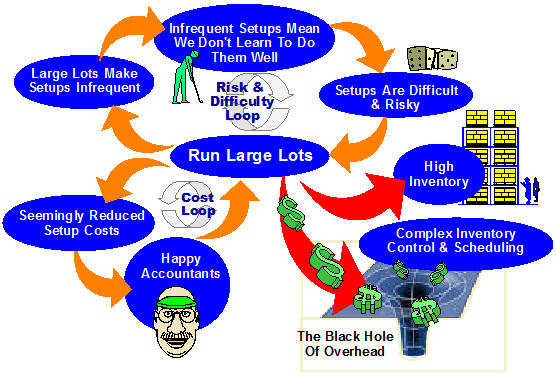
Risk & Difficulty Loop
When we run large lots of each product, setups on that product are infrequent. Setups take skill, practice and coaching, much like golf. When operators perform setups infrequently they do not learn them well. This leads to the perception that setups are difficult and risky. (You never know how long it will take or whether the product will be right). The perceptions of risk and difficulty encourage large lots and thus fewer setups.
Piece Cost Loop
With large lots, a fixed setup cost is amortized over a large number of units. This seems to reduce the unit cost. There are offsetting costs associated with the resulting inventories, but these offsetting costs are usually buried in the overhead. This also encourages large lots or runs.
Results
The consequence is high inventory and complex scheduling. These give rise to a plethora costs and negative consequences. The black hole of overhead sucks in most of the costs. Other penalties such as erratic deliveries are far removed from the fundamental cause and it is difficult to link cause and effect. Limiting mechanisms prevent lot sizes from going to infinity but these are often weak.
The leverage point in this system is in the risk perception loop. If we can make setups fast, easy and predictable the loop reverses into a "virtuous cycle". Easy setups encourage small lots and small lots mean more setups which increases confidence and setup skill. In addition, the piece cost loop becomes very weak.
As a result, inventory comes down and scheduling is easier, The flow of costs into the Black Hole slows as people spend less time expediting, searching and chasing.
Setup reduction (SMED) ties in with many other reinforcing loops in a Lean Manufacturing System. When the loop reverses and lot sizes come down, it allows the use of Kanban and other simple scheduling methods.
Kanban introduces other loops (not shown) that further reinforce the reduction in lot sizes. Workcells are most effective with small lots and setup reduction makes cells feasible or helps them perform better. Kanban also fits well in many workcells.
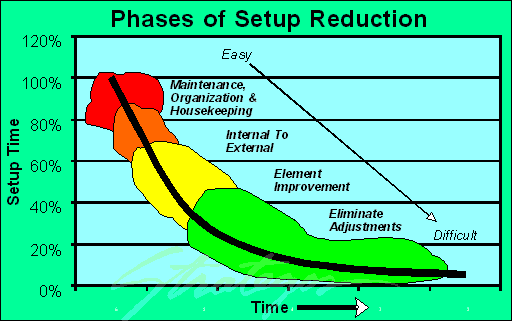
Setup reduction should be approached in four phases or stages as illustrated below. It is usually best to repeat the process through several iterations spaced several months apart. The initial phases of setup reduction (SMED) are straightforward and easy, yet often bring the greatest benefits. People are constantly amazed at how much time is wasted through disorganization and general messiness.
Improving elements and eliminating adjustments will require more imagination, time and cost. Even here, the improvements are sometimes astonishingly simple and easy.
The "Kaizen Event" or "Blitz" is an excellent vehicle for setup reduction. It generates enthusiasm and fast results which make the efforts less mundane.
1. Maintenance, Organization and Housekeeping
It often happens that setup problems are related to poor maintenance such as worn parts, worn tooling, dirt, or damaged threads. Disorganization and poor housekeeping are also contributors to setup problems. These are easy to fix and should be a first step.
2. Internal Elements to External
Internal elements occur when the machine is down. Examine each internal element and see if it cannot be done externally. For example, the pre-heating of an injection molding die could be done before it goes into the machine.
3. Improve Elements
Here we examine every element to see how we can eliminate it, simplify it, reduce the time required or improve it in some other way.
4. Eliminate Adjustments
Adjustments are often the most time consuming, frustrating and error prone parts of a setup.
There are many ways to eliminate them entirely and this is the ultimate goal.

■ ■ ■ ■ ■ ■ ■

|
The Strategos Guide To Value Stream and Process Mapping goes beyond symbols and arrows. In over 163 pages it tells the reader how to do it and what to do with it. |

The free newsletter of Lean strategy