
Macro Layouts
Implementing Manufacturing Strategy
The Macro Plant Layout Project

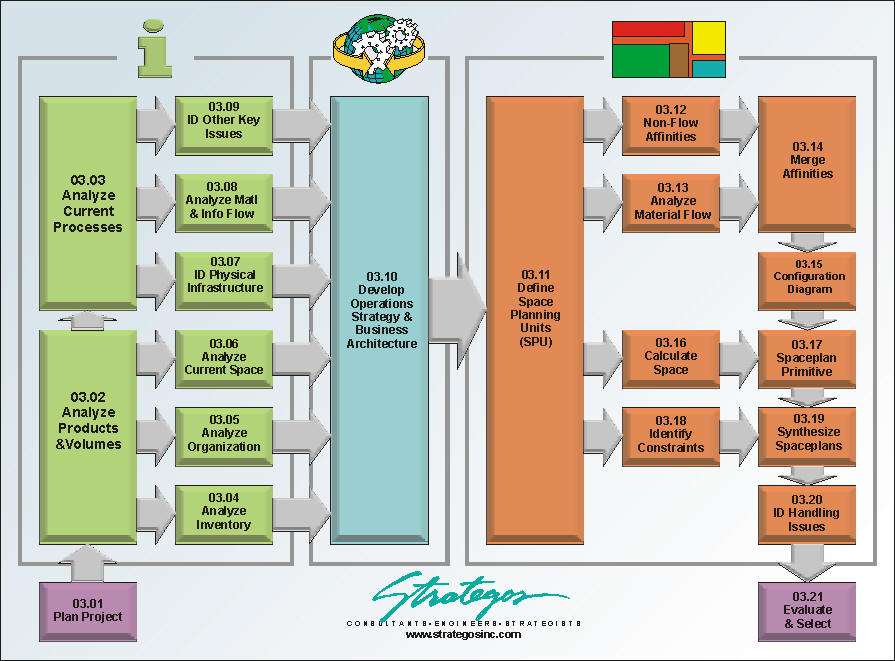
Generalized Macro-Layout Design Procedure
This procedure will develop excellent layouts with a high level of consensus. It saves time and frustration and will minimize backtracking.
The elements of factory layout are simple; the tasks required to develop them is not.
These tasks and their sequence are remarkably similar for many projects. The scope, resources, methods, formality and time required varies according to size and complexity, but each task must be addressed in some way for good results.
Our methodology uses 25 standard tasks with modifications to suit particular projects. The adjacent figure illustrates the tasks and their sequence. This is a "Model" for structuring the work in almost any macro-layout project.
The initial tasks (labeled "Information") plan the project and acquire basic information. These tasks also help to gain consensus and establish a factual basis for the layout. Process Mapping is an important tool here.
These initial tasks also begin the process of paradigm shift. The facts and information gathered and presented are often surprising. We use them to jolt the organization out of its complacency and tendency to "groupthink".
The second category ("Strategy") is only a single task but is , arguably, the most important task and, often, the most neglected. It determines the process and organization of the business. This is where management abandons the past and seriously re-thinks the manufacturing structure.
The third task group designs the spatial layout and associated systems. This is what most people consider as "Plant Layout". While this task group appears complex, it is actually straightforward-- IF the previous task groups have been well done.
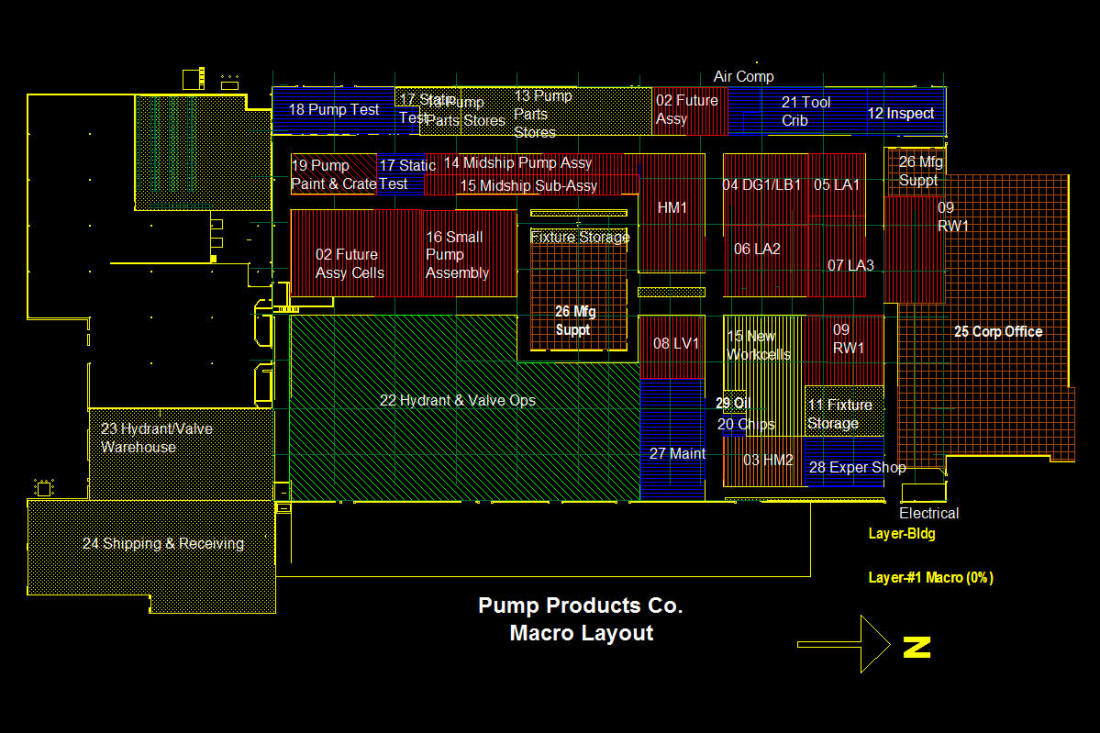
Typical Macro-Layout
This macro-layout is based on a manufacturing strategy that uses workcells for the several thousand components that the company machines for pump. The hydrant and valve operation use dedicated production lines. Some operations within the pump department, such as testing, are centralized in functional areas because of the massive test equipment required.
This procedure produces at least several viable layouts. Each layout has advantages and disadvantages. The final task evaluates the layout options and makes a selection.
The entire procedure can take as little as two weeks or as long as six months. The time depends on project complexity and the strategic orientation of management.
You can find a complete explanation in Mr. Lee's book, "Facilities and Workplace Design - An Illustrated Guide." Our seminar "Workcell Design for Lean Manufacturing" also addresses these tasks and their execution in-depth.
How Material Handling Fits
Material handling should integrate with the layout. We analyze material movement using Equivalent Flow Units and other quantitative methods. This helps select Containers, Route Structures and Equipment.

■ ■ ■ ■ ■ ■ ■

|
The Strategos Guide To Value Stream and Process Mapping goes beyond symbols and arrows. In over 163 pages it tells the reader how to do it and what to do with it. |

The free newsletter of Lean strategy