
Lean Tools & Techniques
Thumbnail Summaries of Lean Concepts
| ID | Element | Purpose | Description |
| 1 | 5S | Reduce wasted time & motion at micro level. | Organized approach to housekeeping that ensures tools, parts and other objects are in known, optimum locations. |
| 2 | Autonomation | Allows automated equipment to operate without human intervention or monitoring. | Uses a wide variety of ingenious devices to monitor automated machines and stop them when problems occur. Developed at Toyota at a time when automated equipment had few devices for preventing defects or malfunctions. |
| 3 | Cellular Mfg. | Simplify workflow and concentrate on a single product or narrow family. It improves quality, inventory and many other parameters. | Cellular Manufacturing organizes small work units of 3-15 people to build a single product or a narrow product family. Ideally the product is completed without leaving the workcell. |
| 4 | Continuous Flow | Coordinate production by ensuring synchronized, continuous flow throughout the value stream. | Continuous flow is the concept of moving product through a value stream at a constant rate throughout that value stream rather than in batches. |
| 5 | Continuous Improvement | To institutionalize the practice of making many small improvements every day and improve overall efficiency like compound interest. | Continuous Improvement refers to the idea that a large number of small improvements in processes are easier to implement than major improvements and have a large cumulative effect. |
| 6 | Design for Six Sigma (DFSS) | To ensure that a product's design is easy to manufacture without defects and meets customer needs. | (DFSS) applies Six Sigma principles to the design of products and their manufacturing processes. |
| 7 | Elimination of Waste | Improve efficiency and effectiveness. | Elimination of waste is an overarching theme of Lean Manufacturing. All the various tools and techniques are aimed at this ultimate goal. |
| 8 | Focused Factories | Align process capabilities with Marketing Strategy & concentrate expertise. | Segregates plants and sections within a plant by markets and product lines. |
| 9 | In-Station Quality Control | Prevents defects from passing to downstream processes and ensures immediate feedback for correction of quality problems. | Uses SPC, pokayoke and conventional inspection to ensure that products do not leave a workstation with defects. |
| 10 | Jidoka | Prevents problems on one station of a production line from building inventory and also creates urgency to find permanent solutions. | Jidoka is the practice of stopping an integrated assembly or production line when any workstation encounters problems. Such stoppages create a crises atmosphere that encourages immediate and permanent solutions. |
| 11 | Kaizen | To improve work processes in a variety of ways. | Kaizen is a generic Japanese word for improvement or "making things better." In the context of Lean Manufacturing, it can apply to rapid improvement (Blitz) or slow continuous improvement (quick & Easy). |
| 12 | Kaizen Blitz | Improve localized production areas quickly and dramatically and overcome inertia common to many organizations. | the Blitz is an intense, highly focused improvement activity intended to redesign and implement major changes within a few days. |
| 13 | Kanban | Schedule production and minimize work-in-process while encouraging improvement in many areas. | Kanban establishes a small stockpoint (usually at the producing workcenter) that sends a signal when items are withdrawn by a downstream process. The producing workcenter simply replaces the items removed. |
| 14 | Lean Accounting | To properly account for lean activities and support the lean initiative. | Includes Activity Based Costing, process costing and other approaches that document lean savings. |
| 15 | Lean Office | Carry Lean principles to activities normally done in an office environment. | Many practices, tools and techniques of Lean Manufacturing can produce similar (or even greater) results in office and administrative environments. |
| 16 | Lean Suppliers | Push improvements upstream in the supply chain | This includes a search for lean suppliers, the development of lean in existing suppliers and a narrowing of the supplier base. |
| 17 | Mfg. Strategy | To ensure a match, or congruence, between the company's markets and production system capability. | Policies and plans that address issues of: capacity, facilities, technology, suppliers, quality, scheduling, organization, personnel, etc. |
| 18 | Mixed Model Production | Smoothes the demand on production processes upstream from a final assembly line. | This refers to Toyota's practice of building multiple models on the same assembly line simultaneously rather than in large batches. |
| 19 | One-Piece Flow | Reduce inventory internal to a workcell and forces improvements and work balance. | One-piece flow is the concept of transferring only a single piece between process steps within a workcell with no accumulation of inventory. It forces near-perfect balance and coordination. |
| 20 | Point-of-Use Storage | Reduce material movement | the practice of storing inventory at the location where it is used rather than in a warehouse or other dedicated storage facility. |
| 21 | Pokayoke | Prevent the occurrence of mistakes or defects. | Uses a wide variety of ingenious devices to prevent mistakes. An example is an automotive gasoline tank cap having an attachment that prevents the cap from being lost. |
| 22 | Process Mapping | To visualize and understand the sequence and nature of events in a process at macro and micro levels. | Invented by Frank Gilbreth about 1913, process mapping visually displays Value-Added and Non-Value Added steps using only a few clear symbols and lines. It lays the foundation for and guides process improvement. |
| 23 | Production Leveling | Smoothes demand variability on processes. | Production Leveling uses various incentives to establish a steady demand rate for each product from the marketplace. |
| 24 | Pull & Synchronous Scheduling | To closely link and synchronize processes and prevent surges of WIP inventory and/or shortages. | Kanban is one method. Direct linkage of processes with conveyors or other devices is another. Broadcast scheduling in which every process in a value stream operates to the same schedule is the third principle method. |
| 25 | Quick & Easy Kaizen | Formalize, spread and maintain continuous improvement activities. | Quick & Easy Kaizen is a term originated by Norman Bodek that describes Toyota's practice of soliciting and rewarding small improvement suggestions from all employees. |
| 26 | Setup Reduction | To minimize setup time and cost thereby freeing capacity and enabling the production of very small lots. | Rapid Setup uses Work Simplification and other conventional techniques to analyze each setup as a process and reduce time and other waste. It also tends to make setups more predictable and improve quality. |
| (SMED) | To minimize setup time and cost thereby freeing capacity and enabling the production of very small lots. | Rapid Setup uses Work Simplification and other conventional techniques to analyze each setup as a process and reduce time and other waste. It also tends to make setups more predictable and improve quality. | |
| 27 | Self Directed Work Teams (SDWT) | SDWTs are the ultimate form teams for managing daily work. | Teams charged with managing their daily work without formal leadership. |
| 28 | Six Sigma | Improve quality, operational performance, practices and systems. | A rigorous, disciplined methodology using data and statistics. |
| 29 | Socio-Technical Systems | Improves the design of factories and offices as well as the quality of work life for individuals. | Eric Trist recognized in the early 1950's interactions between people and technology. Socio-Technical Systems theory identifies principles to optimize these interactions. Lean Manufacturing applies many of these principles. |
| 30 | Statistical Process Control (SPC) | Improve quality and process capability using statistical methods. | SPC uses a variety of analysis and measuring techniques to 1) Establish that a process is capable and 2) that the process is in control (operating normally). |
| 31 | Supplier Development | Applies Lean Manufacturing principles upstream to the supplier base. | Lean Manufacturing works best with suppliers that deliver high quality components precisely when they are needed. Supplier development attempts to locate or train suppliers to do so and develop a network of competent suppliers. |
| 32 | Takt Time | To balance the output of sequential production processes and prevent inventory buildups and shortages. | The average time required between output units at a particular process coordinated with final customer requirements. |
| 33 | Team Development | To provide motivation, improved coordination, reduce management requirements and exploit the knowledge of employees. | Organizes small work groups of 5-15 people for problem solving or work management. Provides structure and interpersonal skills required for decision making. |
| 34 | Total Productive Maintenance | Ensure uptime, Improve process capability and consistency | A maintenance program that combines predictive and preventive maintenance with problem solving and Total Quality. |
| 35 | Total Quality Management (TQM) | Improve quality by preventing defects from occurring. | TQM uses a combination of SPC and problem solving teams to improve process capability and ensure that external factors do not negatively affect the process driving it out of control. |
| 36 | Value Stream Mapping | To visualize macro-level processes and their conformance to Toyota Production System (TPS) principles. | Uses a wide variety of symbols for many elements of TPS and helps determine how to employ these elements in process improvement. |
| 37 | Visual Management | To provide immediate, visual information that enables people to make correct decisions and manage their work and activities. | Visual Management uses a wide variety of signs, signals and controls to manage people and processes. Traffic signs, lights and curbs are the most familiar examples. |
| 38 | Work Balancing | To minimize idle time for people and/or equipment. | Simple technique using bar charts that helps to assign tasks to people and workstations. |
| 39 | Work Simplification | Reduce wasted time and motion at macro level | A techniques that used various Industrial Engineering tools to simplify and streamline work. |
| 40 | Standardized Work | To ensure that all workers execute their tasks in the same manner and thus reduce variation from differences in work method. | Organized approach to work specifications and instructions. As practiced at Toyota, work teams carefully specify the exact manner of performing each task and then adhere to it. Changes are made by the group when that group identifies improvements. |
■ ■ ■ ■ ■ ■ ■
|
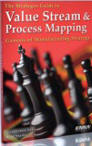
The Strategos Guide To Value Stream and Process Mapping goes beyond symbols and arrows. In over 163 pages it tells the reader how to do it and what to do with it. |

The free newsletter of Lean strategy