
Lean In Hard Times
Surviving & Thriving During Crises
Never Waste A Good Crisis
When hard times (recessions, financial crises) hit the usual reaction is to cut cost in every possible way. Rarely do managers propose new improvement programs or the acceleration of existing efforts. But a crisis is often the best time to implement Lean Manufacturing. Many of the most successful practitioners and originators of Lean started their efforts in the midst of a crisis. We show examples here from Ford Motor Company, Toyota and Harley-Davidson.
There are several reasons why a crisis is the best time to start with Lean. First, a crisis makes the required paradigm shift easier and faster. Second, Lean programs should be self-financing and not require injections of cash. Finally, the cash-flow benefits come very quickly.
The Paradigm Problem
A paradigm is a philosophical or theoretical framework; a way of looking at the world; a mental model (in Senge's terminology). Paradigms operate at both the individual and organizational level.
The human brain, being essentially a self-organizing pattern recognition system (in DeBono's words), tends to bend external facts and phenomena into the established paradigm. The paradigm or model only changes when facts and phenomena can no longer be stretched to fit the paradigm.
In the world of manufacturing, certain paradigms were established in the period from about 1890-1930 when manufacturing had its greatest successes. But the world has changed a lot and the old paradigms are not always valid. Past success makes a paradigm even more difficult to dislodge or change.
Lean operations require a major paradigm shift. When times are hard and the situation desperate it is difficult to ignore the fact that the old paradigm is not working. Hence, the organization is more open to change.
Self Financing
A well-planned and executed Lean implementation is generally self-financing, i.e., the increased positive cash flow pays for the implementation as it goes along. This is especially important when times are tough and credit is unavailable.
Early Cash Flow
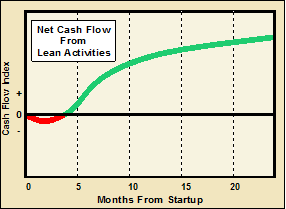
Unlike most business improvements such as computer systems and new equipment, Lean requires little expenditure early in the program and the most dramatic results come early. The figure below shows generalized net cash flow from a well planned and executed implementation.
In the first few months of an implementation, expenditures are usually for some preliminary training, a few kaizen events and changes in procedures. This results in significant inventory reductions that bring in a lot of cash. Productivity improvements require more time and the cash flow is less than the cash flow from decreased inventory.
Later in the implementation, the costs are greater because the activities may include more in-depth training and more investment in equipment and systems. However, by this time productivity improvements are contributing to the positive cash flow. Inventory reductions, while less then they were initially, are likely to continue for several years.
Another way to look at this is to think in terms of exchanging inventory for excess capacity. There is a relationship between inventory and capacity as discussed in our article Inventory, Capacity & Delivery.
The Gift of Desperation
 The pages below contain three examples of well-known firms that were forced into Lean by a
crisis. In each case, the organization was presented with certain catastrophe if they continued
upon their past course. Yet, the crisis forced them to abandon old paradigms. It led them to a
course that not only saved the day but positioned them for decades of growth, profitability and
leadership of their industry. The crisis, it turns out, was a gift--the gift of desperation.
The pages below contain three examples of well-known firms that were forced into Lean by a
crisis. In each case, the organization was presented with certain catastrophe if they continued
upon their past course. Yet, the crisis forced them to abandon old paradigms. It led them to a
course that not only saved the day but positioned them for decades of growth, profitability and
leadership of their industry. The crisis, it turns out, was a gift--the gift of desperation.

■ ■ ■ ■ ■ ■ ■

|
The Strategos Guide To Value Stream and Process Mapping goes beyond symbols and arrows. In over 163 pages it tells the reader how to do it and what to do with it. |

The free newsletter of Lean strategy