
Strategos Book Reviews
Quarterman Lee's Favorites

Some of these books are outside the usual Lean Manufacturing literature. They often give unique insight or contribute to fundamental theory. Some delve into the history and personalities and thus help us understand the present situation or conventional wisdom. All are works that I have read, sometimes over and over. I hope you find them as interesting as I have. --Quarterman Lee
Click On Frames Below For Commentary
Facility Planning and Layout

Facilities & Workplace Design
Download from StrategosFacilities & Workplace Design
Contains important chapters on Site Planning and the design of Workcells. A must-have before re-arranging your factory.--QL
Selected by New Equipment Digest magazine as one of 1998's Best.
Usually a book written by consultants keeps some of the most important aspects of the technique on which they are writing or do not give all the information. This is not the case with this book. Mr. Lee just put everything he knows about facilities design in this book in a way that can be easily followed by any one interested in doing facilities and workplace design. Areas for improvement relate to the quality of some charts that I found a little difficult to read. If you are looking for a "how to do it" in a simple and straightforward way, without any unnecessary material, you need this book. --Migdoel Rodriguez

Warehouse Modernization & Layout Planning NAVSUP Pub 529
Download from StrategosWarehouse Modernization and Layout Planning Guide NAVSUP Publication 529
This massive sourcebook for warehouse design is packed with over 700 pages of illustrations, procedures and design data. It explains how to analyze, select, design and evaluate warehouse operations, plans and equipment. It contains detailed procedure for analysis of inventory and transaction activity and how to use this analysis for equipment selection.
NAVSUP 529 was prepared by The Sims Consulting Group, a Strategos- International affiliate. It has become the de facto standard for all DoD warehouses. The cost and other data is surprisingly accurate even though several years old.

Handbook of Commercial & Industrial Facilities

Handbook of Commercial and Industrial Facilities Management
A company's facilities are often its largest single investment and a key to the effectiveness of its operations.
This book is a complete reference for those who design and manage factory buildings, office complexes, hospitals, and other commercial and industrial facilities. Engineers, architects, and building managers will use it for information on various aspects of designing, evaluating, and selecting facilities plans. They will learn about the latest strategies for managing different types of projects, and get solutions to a wide range of problems, such as leasing, contracts, regulatory matters, construction, and maintenance.

Manufacturing Plant Layout
Manufacturing Plant Layout: Fundamentals & Fine Points of Optimum Facility Design
A step-by-step guide to planning new factories and plant rearrangements by Strategos-International affiliate Ed Phillips. This book has analytical methods for space, activity-pair relationships, materials handling, and alternative layouts. It weaves together layout, cells, JIT, demand-flow and TOC in addition to traditional job shop and line operations.
Accounting and Metrics

Relevance Lost-- A History of Management Accounting
Relevance Lost-- a History of Management Accounting
Describes the evolution of accounting in American business, from the early textile mills to present-day computer-automated manufacturers. "Understanding the reasons behind the obsolescence of existing systems should provide improved rationale for organizational change." Johnson and Kaplan argue that outdated accounting undermines American manufacturers' competitiveness. Many accounting systems report highly inaccurate product costs and provide misleading targets for productivity and efficiency efforts.

The Balanced Scorecard
The Balanced Scorecard
Running a business for the long term requires more than financial metrics. The Balanced Scorecard shows how to link metrics and strategy. It provides a system for investing in customers, employees, new product development, and in systems-rather than pumping up short-term earnings.

Performance Measurement For World Class Manufacturing
Performance Measurement For World Class Manufacturing
Metrics and measurements are important both as gauges to measure progress and as motivators. People respond to the way they are measured. This book has a good balance of theory and practice with many charts and examples. Chapter 9 on measuring social issues is especially good. -QL
Manufacturing Strategy

Competing Against Time
Competing Against Time
This is the FedEx Bible. Absolutely, positively the best piece of work that relates system dynamics to business success.
- Stalk and Hout argue that time is the underlying factor of competitive success.
- Faster product development brings more new products to market ahead of competitors.
- Faster fulfillment is a direct competitive advantage in most markets.
- Faster production increases efficiency and effectiveness.
- Faster administrative processes reduce overhead and costs. Saving time throughout the business increases system stability. -QL

Restoring Our Competitive Edge
Restoring Our Competitive Edge
Topics include: Manufacturing Strategy, Experience Curves, Manufacturing Focus, and Capacity Strategy.
While this book is a bit dated (1980) it is still an excellent source for Manufacturing Strategy. It is especially good for large multi-site companies. It includes an interesting chapter on German and Japanese approaches to manufacturing. -QL

Manufacturing Strategy
Manufacturing Strategy
One of the three or four best books on Manufacturing Strategy. How to develop your Manufacturing Strategy from fundamentals rather than formulae. Hill discovered the mechanism that links manufacturing and marketing strategy: Order-winning criteria. Includes fascinating case studies that bring the subject to life. -QL

Manufacturing: the Formidable Competitive Weapon
Manufacturing: The formidable Competitive Weapon
Wickham Skinner relates some history of manufacturing from the Manufacturing Strategy perspective and outlines the way forward. In this important book the author discusses focused factories and provides the broad outlines that eventually become the discipline of Manufacturing Strategy. A must-read for top manufacturing managers.
The Human Side

Power & Influence
Power & Influence
Excellent book on how individuals can function effectively in today's fluid, informal organizations. Well written and very readable.--QL

Influence Without Authority
Influence Without Authority
This is an individual's guide to effectiveness in modern organizations which require cooperation across lines of authority. Most of us have known people at mid-levels in organizations who have influence that goes far beyond their official position. Cohen and Bradford explain how to build relationships and have a positive effect in your organization.--QL

Decoding The DNA of The Toyota Production System
Decoding The DNA of The Toyota Production System
How does Toyota stay on top year after year and decade after decade? This Harvard Business Review reprint compares corporate culture to the DNA of living organisms. The emphasis is on Toyota Motor Company. -QL
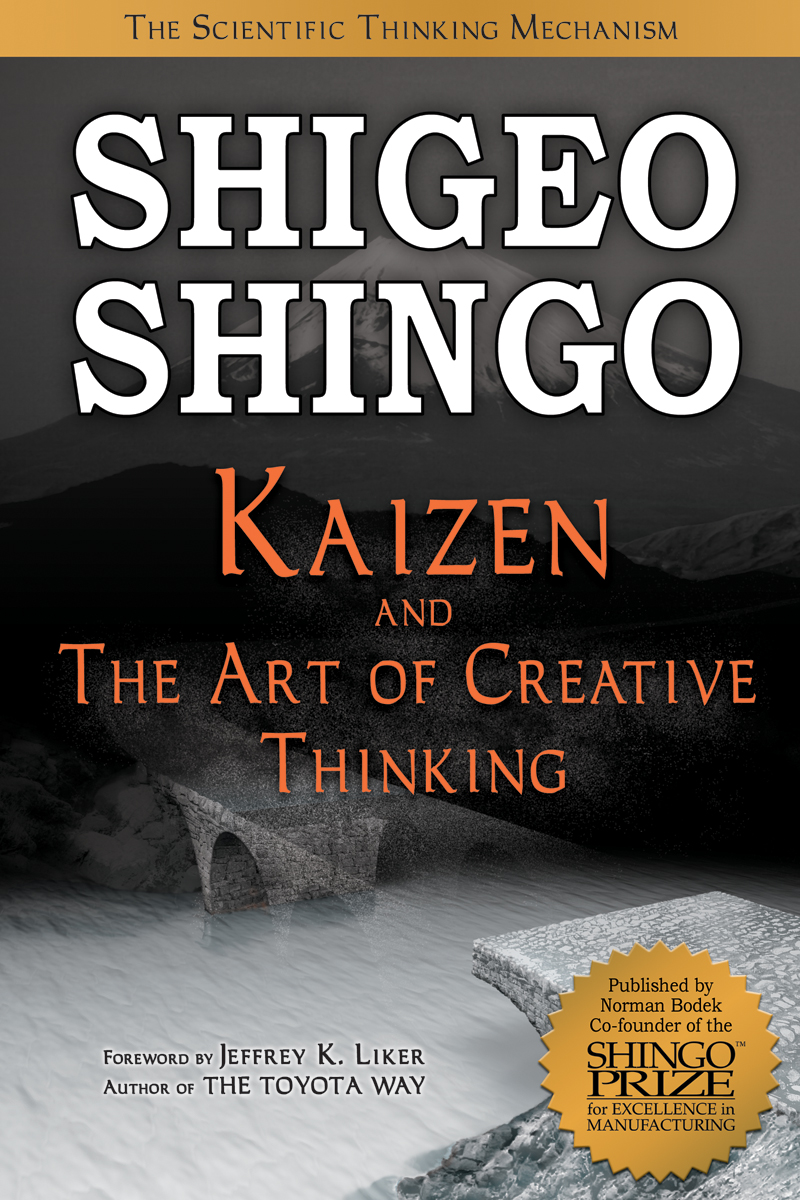
Kaizen & The Art of Creative Thinking
Buy from EnnaKaizen & The Art of Creative Thinking
Problem solving--It seems pretty basic. After all, that is what engineers and managers are supposed to do. Yet, most of us are pretty poor at it as individuals and even worse in group settings. Our thinking is haphazard, we rarely use the available tools and our minds return to minor variations of the familiar. In this book, Shingo explores thinking, problem solving and creativity at a fundamental level. He has the Japanese gift for obsessing on a simple concept until it is understood completely. This contrasts with the usual Western approach of snatching a simple concept and complexifying it beyond all comprehension. The translation and editing is superb.
General Lean

The Goal
The Goal
Written as a novel this book will not overshadow Ernest Hemingway's reputation but it is good. Beware of imagining that you know everything
A "must read" for any manufacturing manager. Goldratt takes some sound concepts from queuing theory and presents them in unique ways.
important after reading it. The Theory of Constraints is not manufacturing strategy but is sound, necessary, underlying knowledge. --QL
Lean Thinking
Lean Thinking
Excellent management-level introduction to Lean Manufacturing and Lean operations. The explanations are simple, sensible and straightforward. It includes case histories from a variety of firms in the US, Germany and Japan. -QL

Zero Inventories
Zero Inventories
The most readable and complete documentation of Toyota and Japanese manufacturing from the 1980's.
Excellent chapters on setup reduction, Kanban, MRP and production control. Also includes early examples from US manufacturers. -QL
Lean Manufacturing History

Ford the Men & The Machines
Ford the Men & The Machines
Excellent history of the Ford Motor Company and the Ford family through 1985. This book gives perspective to Bill Ford's current struggle to once again transform the company.
Includes Ford's early failures, triumph of the Model T, Edsel's struggle with his father, Sorensen's success at Willow Run and Henry Ford II's rebuilding after WWII. -QL

"My Life & Work" &
"Today & Tomorrow"
My Life & Work
Today & Tomorrow
Many consider Henry Ford the originator of
Lean Manufacturing. In these two wide-ranging books, Ford discusses manufacturing, business, and other philosophy.
The books are surprisingly well-written thanks to Ford's ghost writer, Samuel Crowther. The manufacturing parts are profound and prophetic. Take the other parts of Mr. Ford's philosophy with a grain of salt. -QL

The People's Tycoon
The People's Tycoon
A former boss of mine from the mid-1960's had known Henry Ford quite well. He said "The old man wasn't crazy, he just had a damn lousy personality."
Steven Watts explores, in this book, the many sides of Henry Ford that most of the other works have missed about this complex and eccentric man, his personality, motivations and early life.
There is little in this book about manufacturing or Ford's ideas on manufacturing. It is, however, a great read for those who are mystified by some of his stranger behaviors. -QL

Willow Run: Colossus of American Industry
Willow Run: Colossus of American Industry
By late 1944 the Willow Run Bomber Plant was producing more than 20 B-24 aircraft per day. Read about the remarkable industrial achievement of Charles E. Sorensen and the people of Ford Motor Company. Pictures, drawings and plant layout. Just In Time Production on a fantastic scale! --QL
Systems Thinking

The Fifth Discipline Fieldbook
The Fifth Discipline Fieldbook
Senge presents Systems Thinking and Learning Organizations in a practical format. This book is filled with examples, exercises and discussion on how to use The Fifth Discipline. Highly recommended -QL

Business Dynamics
Business dynamics
How are innovative products like plagues? Why do new highways fail to ease traffic congestion? Why is linear growth an illusion? The answers to these and many other questions are in this remarkable book.
Though intimidating at first, if only because of its size, Sterman's book is readable and does not require higher math. He explains the behavior of complex business and other Socio-Technical systems clearly, explicitly and briefly.--QL
 Factory Physics
Factory Physics
The Japanese inventors of Lean Manufacturing were pragmatists. They did not seem to understand, or at least, could not explain why the system worked from a fundamental level. Hopp and Spear offer those explanations.
From the fundamental laws and sciences of physics, systems and queuing theory, they take a quantitative and rigorous approach to factory systems. This book offers many insights. It can be read at a descriptive level or the reader can delve into the detailed math. --QL
 Chaos- Making A New Science
Chaos- Making A New Science
Probably the best layman's introduction to the science of Chaos. Topics include dynamical systems and fractals. Includes history and personalities prominent in the field, fascinating images. Manufacturing systems are highly subject to chaotic effects and knowledge of their behavior is important to manufacturing managers and strategists. -QL
Logistics and Supply Chain

Lean Logistics
Lean Logistics
Michel Baudin has written a very complete but very readable book on Lean Logistics and suppliers.
Perhaps the most important part of this book is Part V where he discusses business relationships, an oft neglected part of the Lean Supplier equation. There is far more to the business of Lean Logistics than many have imagined.

Improving the Extended Value Stream
Improving the Extended Value Stream
Darren Dolcemascolo presents a step-by-step plan for extending lean manufacturing across the entire supply chain. He makes the case for improving the extended value stream by demonstrating the benefits: increased profitability, reduced lead times and inventory, and better quality. Well written and complete.
Cellular Mfg., Workcells and Workstations

Handbook of Cellular Manufacturing Systems
Handbook of Cellular Manufacturing Systems
This is an edited book with many authors. I contributed several chapters. It covers the entire range of Cellular Manufacturing and offers different viewpoints.
The book is well balanced between theory and practice. some chapters are academic and others practical; a complete source on Cellular Manufacturing. --QL

Lean Assembly
Lean Assembly
Excellent management-level introduction to Lean Manufacturing and Lean operations. The explanations are simple, sensible and straightforward. It includes case histories from a variety of firms in the US, Germany and Japan. -QL
Facilities & Workplace Design
Facilities & Workplace Design
Contains important chapters on Site Planning and the design of Workcells. A must-have before re-arranging your factory.--QL Selected by New Equipment Digest magazine as one of 1998's Best.
Usually a book written by consultants keeps some of the most important aspects of the technique on which they are writing or do not give all the information. This is not the case with this book. Mr. Lee just put everything he knows about facilities design in this book in a way that can be easily followed by any one interested in doing facilities and workplace design. Areas for improvement relate to the quality of some charts that I found a little difficult to read. If you are looking for a "how to do it" in a simple and straightforward way, without any unnecessary material, you need this book. --Migdoel Rodriguez
■ ■ ■ ■ ■ ■ ■
|
The Strategos Guide To Value Stream and Process Mapping goes beyond symbols and arrows. In over 163 pages it tells the reader how to do it and what to do with it. |

The free newsletter of Lean strategy