
Action Learning
Beyond Kaizen-- Action Learning
Introduction
 Action
learning promotes
individual and organizational learning
through small teams. These teams address real problems and learn from their attempts to change things.
Action
learning promotes
individual and organizational learning
through small teams. These teams address real problems and learn from their attempts to change things.
The most important aspect of Action Learning is its ability to promote cultural change. The surface simplicity of Action Learning can mask its real power. It not only provides learning for individuals and the organization. It also solves intractable problems and generates significant changes in corporate culture.
Action Learning shares many characteristics with Kaizen events and process improvement teams. Indeed, some process improvement teams or Kaizen teams are, in fact, Action Learning teams. Figure 1 shows the general process. Click here for a comparison of Action Learning, Kaizen and Task Forces.
Benefits
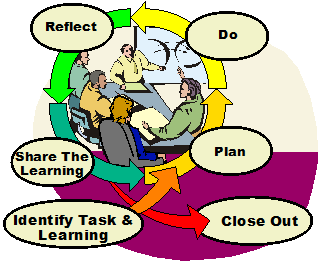
Figure 1 the Action Learning Process
The benefits of Action Learning come at two levels. At an individual level, people learn through doing. They learn about technical issues such as workcell design. They learn about team processes and how to function in teams. They also learn leadership and cooperation skills. Action Learning gives team members confidence in their abilities to learn while promoting an appropriate humility about their actual knowledge.
At the organizational level, companies need to learn coping skills for new problems. The rate of change in the external environment is accelerating and has been for several decades. It is only likely to accelerate more.
For survival, organizations must learn at least as fast as the pace of change and, preferably faster. they must become learning organizations or lose competitive advantage.
Existing knowledge about how things work, or are supposed to work, often misdirects inquiry rather than facilitates a solution.
Action Learning promotes the kind of Corporate Culture that allows companies to survive in these changing environments.
Reg Revans was careful not to define Action Learning in a rigid way. He left the concept open for growth, experimentation and development. Others have attempted more definitive models. As a result, Action Learning teams operate with a wide variety of formats on a wide range of problems. However, most practitioners would agree on this summary of basic elements.
Revans’ Learning Formula
Reg Revans described Action Learning with the formula L = P + Q, where Learning (L) occurs through Programmed knowledge (P) and insightful Questioning (Q).
Traditional instruction, or “programmed knowledge” is appropriate when we are faced with puzzles, i.e., challenges that have a right answer. However, when we are faced with “problems”, challenges that have no right answer, we need critical reflection or questioning insight. Action learning encourages such reflection by providing the support to enable people to learn from challenges as well as from themselves and the group itself.
There are substantial benefits of learning on all these multiple levels.
The knowledge is more likely to be transferable to other situations.
Participants engage in double loop learning. They not only learn new facts but also investigate their own underlying assumptions and mental models. They learn how to learn.
Learning Teams (Sets)
Action Learning is always a team effort. Revans referred to these teams as “sets.” Team concepts had not been developed when Revans did his original work. The problem often lies outside the expertise and knowledge of some or all of the team members. This is an important part of the learning experience. A team consisting only of experts in the area of the problem would be unlikely to question basic assumptions and mental models.
Real Problems
The team is given a real problem and they are expected to solve it. Contrived classroom exercises are not compatible with Action Learning. The problem should also be a challenging problem, e.g. one of those recurring, intractable problems that seem to haunt organizations, a problem where many people think they know the answer but all their answers are different.
Learning Dominates
The problems and situations undertaken by an Action Learning team are genuine, important and difficult. However, the learning experience should be the primary goal. Solving the problem is a happy but collateral result. This is primarily what distinguishes Action Learning from the typical Kaizen Event or task force.
Problem Solving Procedure

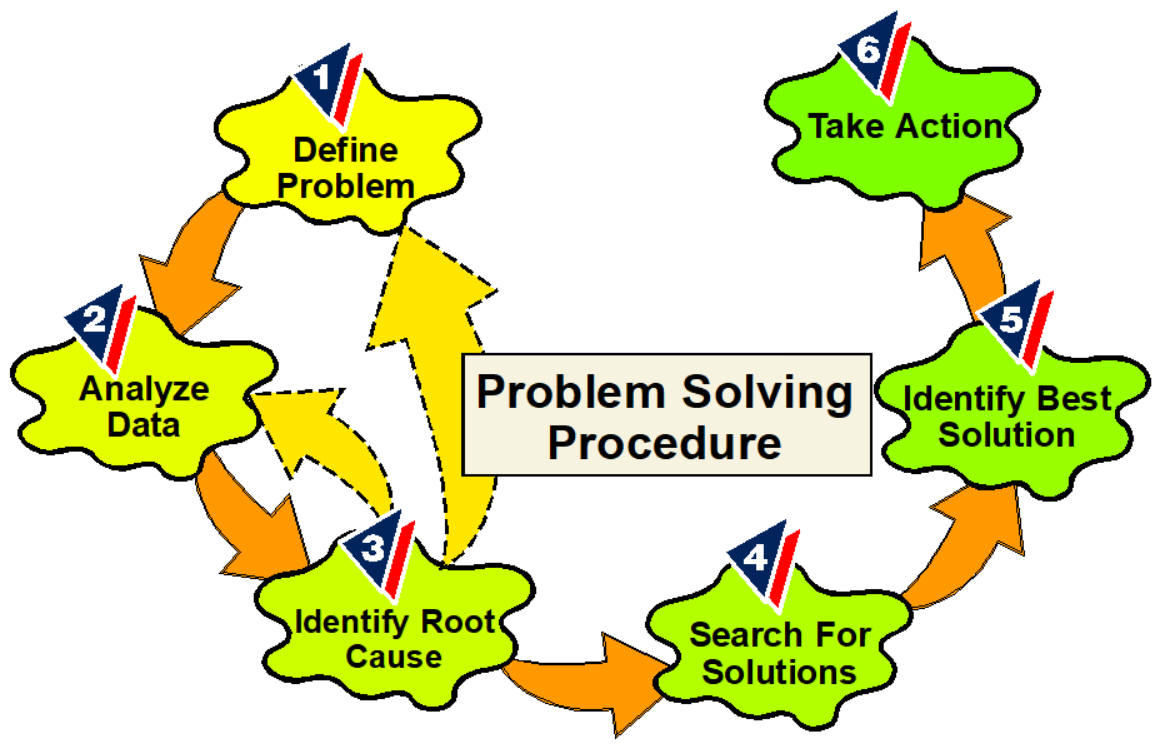
Figure 3 Problem solving Procedure
The team needs a formal problem solving procedure, another adaptation from the early Work Simplification movement, figure 3. The formal procedures prevent a rush to judgment or knee-jerk responses. They structure the process and focus attention towards the immediate task. A number of such procedures are popular as part of TQM and Six Sigma. In essence, they are similar and most provide an adequate framework.
Reflection Is As Important As Action
In figure 1 "Reflection" is one of the four essential elements of the Action Learning cycle. This is where the team and its individual members review their activities and internalize their approaches to solving the problem. Reflection consists of both individual and group exercises. Some of the questions that are considered might be:
- When was I most engaged?
- When was I most distanced?
- When was I most affirmed?
- When was I most puzzled?
- What was the most important thing I learned today?
- How will I capitalize on it in the future?
Such questions may appear simplistic and, indeed, they can have simplistic responses. However, when properly guided by an effective facilitator, these questions lend power and depth to the group's answers.
These questions focus on individual learning. Other questions would be asked of the group and answered by the group. Such group questions have long been used in Team Development to promote learning of group processes.
Always Start With Questioning
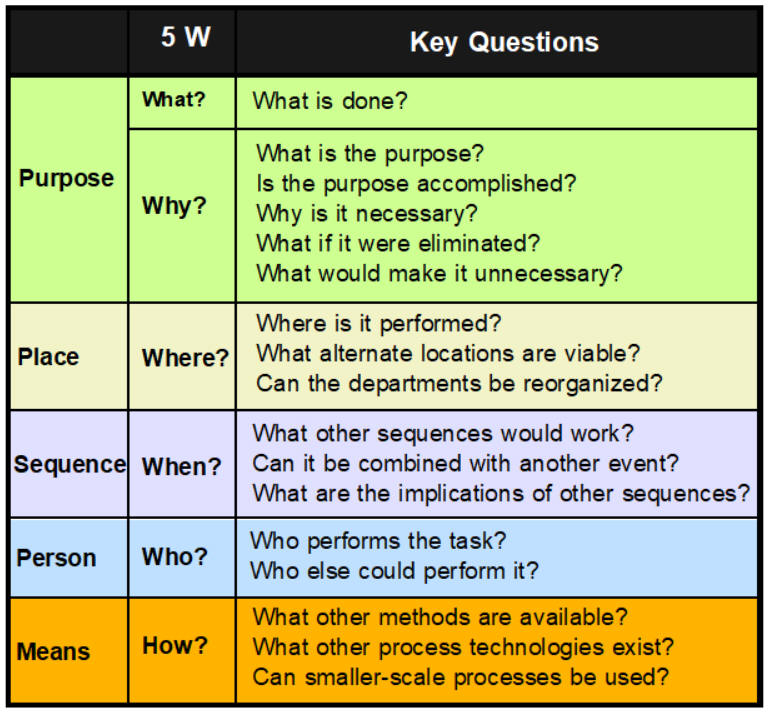
At the beginning of an Action Learning project, the most important questions concern the purpose. People embroiled in the process every day rarely ask the first three questions in the "why" category. Yet they are often the most important. It is surprising how many times we find that a whole series of work activities are unnecessary or how often activities simply do not accomplish their purported purpose.
The "questioning Attitude" was formalized by Ralph Barnes in the 1930's and popularized by Allan Mogensen in the 1940's and 1950's. It encouraged the repeated asking of questions about every aspect of a problem situation. Figure 2 presents the more useful questions.
When the purpose is necessary, the final question in the "Why" category, "What would make it unnecessary," is often the most intriguing. This is a question that leads backwards to root causes that often lie outside the apparent scope of the project. It is also one of the "Lateral Thinking" techniques promoted by Edward DeBono and can lead to breakthrough solutions.
Then, question categories of Place, Sequence, Person and Means apply later in the problem-solving process.
Share The Knowledge
For many reasons Action Learning teams share their knowledge with the remainder of the organization. They usually do this through group presentations. The presentations and reports are not necessarily at the end of the project. The group may make interim presentations so that others in the organization can follow the logic, advance their own thinking and contribute valuable information.
Those outside the group cannot gain the full learning without the actual experience. However, they can gain some insight. The most important result of sharing is to build enthusiasm and support for the process within the organization and to encourage others to participate in future sessions. This is also part of the recognition and reward structure for the group itself. Sharing the knowledge promotes the change in corporate culture that is, probably, the most significant benefit of Action Learning.
The Beginning
Since
the Action Learning team is new, it is important for the group to spend
time getting to know each other and develop group norms.
This process need not be as lengthy or elaborate as it would be with a self-directed work team.
The team may also need formal training in certain areas such as workcell design or process
improvement.
Fixing The Problem Versus Learning
Several thousand years ago it was pointed out that teaching a hungry person to fish was better than giving them a fish to eat. Not much has changed in that respect.
The primary goal of Action Learning is the learning experience. Solving the problem is important but secondary to learning. It is easy for the group and easy for management to get caught up in the problem and shortcut the learning component.
Timeframe
The Active Learning team establishes a timeframe for the project in the early planning stage. This timeframe should allow for learning processes includes formal reflection and informal internalization of knowledge between sessions.
Facilitation
Facilitation practices in Active Learning vary widely and there is a range of opinion about their best role. Some facilitators are active in the beginning and then fade away as the group progresses. Others stay with the group throughout the project. However, some things are generally agreed.
-
Facilitation is most important in the beginning. This is where the facilitator guides the group in establishing norms, explaining the goals and ensures that planning is consistent with Active Learning principles.
-
The facilitator must not dominate the group or solve the problem for them. A facilitator may allow the group to flounder and, apparently, waste time. This time, however, is not really wasted; it is part of the learning process. The most important learning usually comes from struggling, floundering and making mistakes.
-
The facilitator should always be available, if the team requests help, to smooth group processes or provide specific training or expert advice.

■ ■ ■ ■ ■ ■ ■

|
The Strategos Guide To Value Stream and Process Mapping goes beyond symbols and arrows. In over 163 pages it tells the reader how to do it and what to do with it. |

The free newsletter of Lean strategy